Now, I know what some of you are thinking, “Of course she didn’t, she spoke French!” But, in fact, she didn’t say “Qu’ils mangent de la brioche” either. This saying in France actually pre-dated her arrival there by anywhere from about thirty years to as much as a century!
So how did this saying get attributed to Marie Antoinette? Primarily, because the people of France loathed her. If you read up on her history, you’ll find most of this loathing was primarily because she was an easy and very visible target to vent their rage against the French aristocracy on.
While American delegates were gathered at the Constitutional Convention in Philadelphia, the seeds of another revolution were being planted across the Atlantic Ocean. Like the American Revolution, the French Revolution was inspired by Enlightenment philosophers and a dedication to the ideals of liberty and equality.
Exorbitantly high taxes, national debt, and a mostly apathetic monarch pushed the French working class and peasantry to demand changes. When these demands were not met, radicals chose instead to dissolve the government and form an entirely new one. The French Revolution was a radical assault on France's traditional institutions—the monarchy, the Church, feudalism—and thoroughly transformed French society.
Now that we've studied the leaders of revolutionary movements in England, France, and Latin America, let's take a look at George Washington and why he was uniquely qualified to lead the Continental Army during the American Revolution. Watch the video linked above and then type your answers to these questions:
1) What previous experience did George Washington have in leading troops?
2) What colony was Washington from?
3) Why were some of the delegates at the Second Continental Congress hoping to have someone from Washington’s colony be commander?
4) How did Washington gain his wealth?
5) What did Washington wear to the Second Continental Congress that might have shown his “ambition” to be Commander?
6) What does the video say about Washington’s height? Why do you think his height affected what people thought of him?
7) List two adjectives that historians used to describe Washington’s character.
8) Washington was described as having a “ruthless and intense focus.” What does this mean to you?
9) What makes a good leader?
10) Think about some of the characteristics that you said make a good leader. How does George Washington compare?
Three contestants claim to be the same person. Four celebrities question the contestants,then vote for the one they think is the real person. This simple game has endured as aTV classic for over 45 years. Today's assignment pays tribute to the show that asked theburning question...
"Will the real ________ please stand up?"
With your group you are each to choose a fact for the historical figure assigned you. Use yourBiography Handout as a resource. All of your facts should be made false except one. After presenting your facts in front of the class they will try to guess which is true.The more realistic/ believable your facts the better chance you have of fooling your classmates and winning the game.
"THESE are the times that try men's souls. The summer soldier and the sunshine patriot will, in this crisis, shrink from the service of their country; but he that stands by it now, deserves the love and thanks of man and woman. Tyranny, like hell, is not easily conquered; yet we have this consolation with us, that the harder the conflict, the more glorious the triumph."
On January 9th, 1776, the pamphlet "Common Sense" was published in Philadelphia. The pamphlet immediately becomes a bestseller, selling tens of thousands of copies across America. In "Common Sense," Thomas Paine, the author and violent foe of aristocracy and monarchy, attacks the King and Parliament and offers Americans an alternative to British rule: true independence.
Paine’s groundbreaking pamphlet Common Sense is not only one of the best selling publications in American history; it was the intellectual spark that lit the fuse for the American Revolution.
In contrast with many of the other Founding Fathers, who came from money, Paine was born into humble circumstances in England. His life was a roller coaster of ups and downs. He won great praise but his writings also generated a great deal of controversy.
Thomas Paine died in New York in 1809. Because of his controversial writings against orthodox religion in The Age of Reason, the local Quaker cemetery refused to let him be buried there. He was buried instead on his farm. In 1819, an English journalist named William Cobbett dug up Paine's bones. Cobbett wanted to give Paine a hero's reburial in England. The plan failed, the British public did not care, and the bones remained in Cobbett’s possession when he died. After that, the bones were scattered and lost.
Wolfgang Amadeus Mozart came to fame during the Age of Enlightenment. His compositions were informed by the spirit of that era, and Enlightenment ideas were integral to his music, particularly the operas. In fact, whether we would even have some of his most beloved operas without the guiding principles of the age is doubtful.
Mozart’s genius did not spring forth in isolation. In fact, he was very much engaged in the world around him, and his “moment,” so to speak, coincided with the full flowering of the Age of Enlightenment. New thinkers – among them Voltaire, Rousseau, and Diderot – sought to flush away medieval attitudes about religion and the “divine right” of kings and replace them with a revolutionary faith in reason, order, and science.
By the High Middle Ages (about 1000–1250 C.E.), Western Europeans had developed the system of feudalism. Feudalism provided people with protection and safety by establishing a stable social order.
Under this system, people were bound to one another by promises of loyalty. In theory, all the land in the kingdom belonged to the monarch (usually a king, but sometimes a queen). A large amount of land was also owned by the Church. The king kept some land for himself and gave fiefs (FEEFS), or land grants, to his most important lords, who became his vassals. In return, each lord had to supply the king with knights in times of war. A lord then enlisted lesser lords and knights as his vassals. At times, these arrangements were written down, and some of these contracts even survive to this day in museums.
At the bottom of the social system were peasants. Lords rented some of their land to the peasants who worked for them. However, some peasants, called serfs, were “tied” to the land they worked, which meant that they could not leave the lord’s land without permission and had to farm his fields in exchange for a small plot of their own.
Why did Feudalism work? What choice did the peasants have? Was it fair?
A key figure in the British Enlightenment was the Scottish philosopher Adam Smith. His book The Wealth of Nations laid the foundations for modern economics. Smith believed that a free market was driven by competition and individuals' self-interest. These drivers serve as an "invisible hand" that guides market activity to the benefit of society as a whole.
It is his own advantage, indeed, and not that of the society, which he has in view … He intends only his own gain, and he is in this, as in many other cases, led by an invisible hand to promote an end which was no part of his intention.
—Adam Smith, The Wealth of Nations, 1776
However, Smith also argued that a successful economic system must help the poor. As he wrote: "No society can surely be flourishing and happy, of which the far greater part of the members are poor and miserable."
What if some of the greatest mysteries of human history have been misunderstood?
Imagine standing before the Great Pyramid of Egypt, looking up at millions of enormous stones fitted together with remarkable precision. Or imagine seeing the giant statues of Easter Island, the mysterious lines of Nazca, or ancient drawings that seem to show strange machines and flying objects. Who built these things? How did they do it? And where did their ideas come from?
Von Däniken travels across history looking for clues. He examines ancient monuments, maps, myths, religious stories, and unusual artifacts. He points to places such as the Egyptian pyramids, the Nazca Lines in Peru, Tiahuanaco in Bolivia, Easter Island, and ancient Maya cities. He argues that some of these achievements seem difficult to explain using the technology we normally associate with ancient civilizations.
He also looks at ancient stories. What if descriptions of gods flying through the sky were not stories about supernatural beings—but memories of real visitors arriving in advanced machines? What if ancient pictures that appear to show strange vehicles or figures in unusual clothing were attempts to record encounters with technology people did not understand?
It is important to remember that Von Däniken's ideas are controversial. He often presents questions and unusual possibilities as evidence for his theories. Many historians and archaeologists disagree with his conclusions and argue that ancient Egyptians were capable of extraordinary engineering without help from extraterrestrials.
As you read, don't simply ask, “Do I believe Von Däniken?”
Ask the historian's questions:
What is the evidence? What other explanations are possible? Is the evidence being interpreted fairly? What information is missing? And what evidence would convince me that the claim is true—or false?
The mystery is not only what happened in the ancient past.
The mystery is also how we know what we think we know about it.
"History is a Greek word," wrote British historian Arnold Toynbee, "which means, literally, just investigation." The process of investigating what happened long ago is a process that involves analyzing evidence, determining a source's credibility, and evaluating different points of view about what is important and why.
These are all essential critical-thinking skills, not just for the history classroom, but also for life. You will need to exercise these skills whenever you make an important decision about your own future. These skills will also help you make more informed decisions about public issues as a citizen and voter.
Listen to the story and then use the process of investigation to answer these questions:
1) What historical evidence did the archaelogists find?
2) How credible was the evidence?
3) Evaluate their point of view. What did they get right? What did they get wrong?
4) What does this story teach us about our study of the past?
Suppose you are a historian who found this stone etched with a statement.
What questions would you ask about this stone?
How would you use it to interpret the past?
For centuries, scholars puzzled over the hieroglyphs they found carved onto ancient Egyptian ruins, tablets, and papyri. But in 1799, a unique discovery would finally help unlock their meaning. It was a stone inscribed with three different texts: Egyptian Hieroglyphs, Demotic Egyptian, and Ancient Greek.
Read the introduction in the text, then watch this video in which Franziska Naether shares how scholars decoded the ancient message of the Rosetta Stone.
There has never been a decade quite like the sixties; the diversity, conflicts, hope, anger, the music. The 60s decade was a decade of change. Not only were those changes evident in pop culture, music, & fashions; they changed the course of history.
As you watch the film in class read the corresponding sections in the text:
41.3 Marriage Families and a 'Baby Boom'
44 Civil Rights Revolution: "Like A Mighty Stream" 45.1 Redefining Equality: From Black Power to Affirmative Action
47 The Age of Camelot
49 Emergence of a Counterculture
50 - The United States Gets Involved in Vietnam
51.4 Growing Opposition to the War
Answer these questions in your final essay. One paragraph per answer.
I. Why did the counterculture fall apart?
II. Were the 60's good or bad for America? Why?
III. What lessons did the 60's teach us?
IV, Which character in the film did you relate to most? If you were them what would you have done differently?
V. Would you have wanted to live during the 60's? Why or Why not?
The friendliness of Tic-tac-toe games makes them ideal as a pedagogical tool for teaching the concepts of good sportsmanship and the branch of artificial intelligence that deals with the searching of game trees. It is straightforward to write a computer program to play Tic-tac-toe perfectly, to enumerate the 765 essentially different positions (the state space complexity), or the 26,830 possible games up to rotations and reflections (the game tree complexity) on this space. An early variant of Tic-tac-toe was played in the Roman Empire, around the first century BC. It was called Terni Lapilli and instead of having any number of pieces, each player only had three, thus they had to move them around to empty spaces to keep playing. The game's grid markings have been found chalked all over Rome. However, according to Claudia Zaslavsky's book Tic Tac Toe: And Other Three-In-A Row Games from Ancient Egypt to the Modern Computer, Tic-tac-toe could originate back to ancient Egypt.[1] Another closely related ancient game is Three Men's Morris which is also played on a simple grid and requires three pieces in a row to finish.[2]
The different names of the game are more recent. The first print reference to "Noughts and crosses", the British name, appeared in 1864. The first print reference to a game called "tick-tack-toe" occurred in 1884, but referred to "a children's game played on a slate, consisting in trying with the eyes shut to bring the pencil down on one of the numbers of a set, the number hit being scored".
Use the Tic Tac Toe handouts at the front of the room to challenge your classmates and then answer these questions:
1) What strategies did you use to win?
2) Why does Tic Tac Toe lose its appeal the more you play?
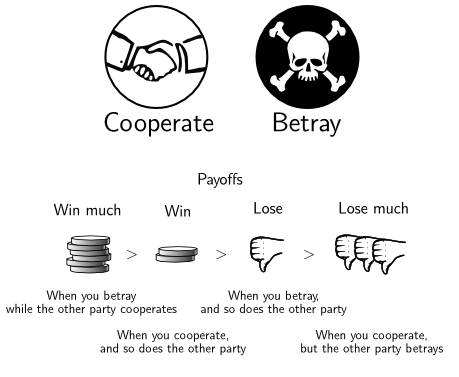
During the Cold War the opposing alliances of NATO and the Warsaw Pact both had the choice to arm or disarm. From each side's point of view, disarming whilst their opponent continued to arm would have led to military inferiority and possible annihilation. Conversely, arming whilst their opponent disarmed would have led to superiority. If both sides chose to arm, neither could afford to attack the other, but at the high cost of developing and maintaining a nuclear arsenal. If both sides chose to disarm, war would be avoided and there would be no costs. Although the 'best' overall outcome is for both sides to disarm, the rational course for both sides is to arm, and this is indeed what happened. 'Mutually Assured Destruction' was the idea that waging war would be so destructive to both sides that neither could possibly win. Both sides poured enormous resources into military research and armament in a war of attrition for the next thirty years until reform in the Soviet Union caused ideological differences to abate.
The Cold War and arms race can be modeled as a Prisoner's Dilemma. The Prisoner's Dilemma is the story of two criminals who have been arrested for a heinous crime and are being interrogated separately. Each knows that if neither of them talks, the case against them is weak and they will be convicted and punished for lesser charges. If this happens, each will get 20 years in prison with the possibility of parole. If both 'rat' on each other, its a slam dunk case for the prosecution and they both face death sentences. If only one person 'rats' and testifies against the other, the one who did not cooperate will get the death sentence while the other will go free.
1) What would you do? Why?
2) What did your partner do? What was the result?
3) What was the surprising outcome of the Hollywood version we watched in class?
4) What is M.A.D. and how has it kept us safe from nuclear annihilation?
The North Atlantic Treaty Organization (NATO) was established in 1949. The primary goal of this "league" was to ensure security against incursions from the Soviet Union and to prevent the expansion of communism across Europe. It was built on the idea of shared interests and cooperation between the United States, Canada, and Western European nations.
Much like NATO, the first official 'Justice League' was founded when 'Super Friends' Wonder Woman, Aquaman, Superman, Batman, Martian Manhunter, Flash, and Green Lantern united to stop an invasion of alien warriors. Following the victory, Batman suggested forming a "club," which the Flash named a "league against evil." They would later meet in their headquarters, named the "Hall of Justice."
The Warsaw Pact represented the organized opposition to NATO. A defining feature of the Warsaw Pact was the Soviet Union’s control over its "satellite states" in Eastern Europe. This mirrors the structure of the Legion of Doom (or Injustice League), which is often depicted as a collection of powerful villains working under Lex Luther, Superman's singular, dominant nemesis.
1) How did the United States become a 'Superpower?' What was our origin story?
2) What are the similarities/ differences between NATO & the 'Justice League?'
Between the Warssaw Pact and the 'Legion of Doom?'
3) What are the benefits of being part of NATO? Risks?
4) How has NATO evolved & changed over the decades?
5) In your opinion should the United States continue to lead NATO? Why/ Not? What does President Trump think?
Welcome to the home page of Mr. Kelly's History class, Talawanda High School, Oxford, Ohio, USA. Here you will find assignments, links to lessons, your grades, and online discussions. Please remember that this site is an online extension of our classroom and to treat each other with respect. Thanks and BE BRAVE!