Monday, September 29, 2025

The Wonderful Wizard of Oz


Ever since its publication in 1900 Lyman Frank Baum's The Wonderful Wizard of Oz has been immensely popular, providing the basis for a profitable musical comedy, three movies, and a number of plays. It is an indigenous creation, curiously warm and touching, although no one really knows why.


Political interpretations of The Wonderful Wizard of Oz include treatments of the modern fairy tale  as an allegory or metaphor for the political, economic and social events of America of the 1890s.

In a 1964 article, high school teacher Henry Littlefield outlined an allegory in the book regarding monetary policy. According to this view, for instance, the "Yellow Brick Road" represents the gold standard, and the silver slippers (ruby in the film version) represent the Populist Party's desire to construct a bimetallic standard of both gold and silver in its place.

Dorothy learns that to return home, she must reach the Emerald City, Oz's political center, to speak to the Wizard, representing the President of the United States. While journeying to the Emerald City, she encounters a scarecrow, who represents a farmer; a woodman made of tin, who represents a worker dehumanized by industrialization; and a cowardly lion, who represents William Jennings Bryan, a prominent leader of the Silverite movement. The villains of the story, the Wicked Witch of the West and the Wicked Witch of the East, represent the wealthy railroad and oil barons of the American West and the financial and banking interests of the eastern U.S. respectively.

Baum did not offer any conclusive proof that he intended his novel to be a political allegory and Historian Ranjit S. Dighe wrote that for sixty years after the book's publication, "virtually nobody" had such an interpretation. None-the less the comparisons are compelling.

Do you think Baum's portrayal of the Populists was positive or negative? Why?

What modern day movies could be used as allegories?

Why do you think The Wizard of Oz lives on in Popular culture? What about the story appeals to new and old generations?

Still not convinced? Watch The Secret of Oz for more on the symbolism.

The Dark Side of the Rainbow launched a whole new craze based on the movie. Coincidence, Apophenia, or Synchronicity?

Wonder which character of Oz you are? Take the quiz.

Friday, September 26, 2025

The Real All Americans


Pennsylvania's Carlisle Indian School, founded by Richard Pratt, may have failed to assimilate Native Americans  in society but the school's football team proved their respectability by challenging — and beating — their counterparts in the Ivy Leagues and Military Academies. Although the school shut its doors in 1918, the winning team established Jim Thorpe and coach Glenn "Pop" Warner as two of the best-known names in American sports. It also introduced plays, including the forward pass, that are standard in the game today.

Hear author Sally Jenkins read from her book: The Real All Americans

Pop Warners playbook included more than just the forward pass. His 'hidden ball play' and other 'trick plays' became legendary in football lore.

Watch these 'Trick Plays' and then design one of your own.

Who knows? If its good enough maybe the Brave can use it Friday night.

How did Football, in many ways, became a substitute for war?

Thursday, September 25, 2025

What's In a Name?


The drive to assimilate Indians into the mainstream of American life by changing their customs, dress, occupations, language, religion and philosophy has always been an element in Federal-Indian relations. In the latter part of the 19th century and the early part of the 20th century, this assimilationist policy became dominant. A major thrust of assimilation efforts was to educate Indians in American ways. in 1879 the Carlisle Indian Training School was established by a former military officer. Its 'benevolent philosophy' of separating Indian children totally from their Indian environment was supposed to help them not cause harm. Forcing Indians to adopt white ways became the basis for a widescale boarding school movement that eventually removed thousands of Indian children from their cultural settings and families. The motto: 'KILL THE INDIAN, SAVE THE MAN.'

Can you really change a person by cutting their hair or renaming them?

What about a school?


The "Braves," an American Indian warrior, became the symbol of the Talawanda Schools in the 50s after a contest was held to name the newly consolidated district formed by Sommerville, Hanover, Milford, and Oxford. Hannover 5th grader Karen Irwin won with the name 'Tallawanda' because Tallawanda Creek (aka 4 Mile Creek) flowed through the three newly merged townships. After some discussion the second 'l' was dropped and the new High School on Chestnut Street opened in 1956 where it remained for then next half century.

But who was Talawanda?  What did the name mean?


In 2018 the Talawanda school board voted 3-2 to change the high school’s mascot from “Braves” to “Brave” after a meeting lasting more than three hours.

A heated crowd filled the Performing Arts Center at Talawanda High School to listen to the recommendations made to the board by the superintendent-appointed branding committee.

The change responds to complaints that the name and logo currently used by Talawanda are offensive. Many feel that the logo is more of a “caricature,” depiction of what a Native American would look like, and others feel that they are simply honoring Native Americans with the “Braves” name.

Should we be proud to have the 'Brave' as our Mascot or change it to something else?


Wednesday, September 24, 2025

Battlefield Detectives


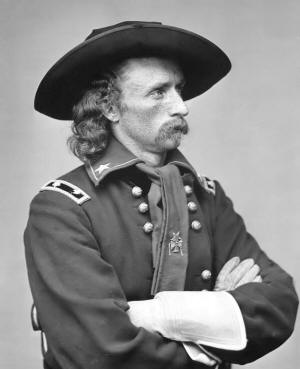
George Armstrong Custer, the young Civil War hero turned Indian fighter, was trapped on a desolate ridge overlooking the Little Bighorn River in the territory of Montana. Swarms of well-armed Indians surrounded him. According to legend–and many historians–Custer rallied his vastly outnumbered troops. The desperate 7th Cavalry soldiers shot their horses to make barricades and fought ferociously as hundreds of Indians, led by famed Sioux war chief Crazy Horse, overran the ridge.

But because Custer's men were wiped out before reinforcements arrived, a definitive account of the Little Bighorn battle has eluded historians. The only eye witnesses were the Indians, who had conflicting recollections. And so the legend of "Custer's last stand" began to take shape. "The image of Custer blazing away till the very end with his pistols was an icon of the American West," says John Dorner, chief historian at the Little Bighorn Battlefield National Monument.

The lack of reliable accounts has kept the details of the battle a hotly debated topic, and discoveries in recent years have challenged the heart of the legend. "The myth is the gallant, heroic last stand–that the Indians drove him to the killing field, where he fought to the last man and last bullet against overwhelming odds," says Richard Fox, a professor of anthropology at the University of South Dakota.

Fox, who specializes in archaeology, completed an extensive battlefield survey after a 1983 wildfire and revealed evidence that cut to the core of the Custer legend. "My research says the outcome was a function of panic and fear, a very common thing in battle. There was no last stand in the gallant, heroic sense."


Tuesday, September 23, 2025

Hollywood Indians

"A Nation that does not know its history has no future."
What does this saying mean? How has Hollywood stereotyped the Indians in the movies? Why?

How is what happened in history very different than the Hollywood stereotype of the Indians as warriors?

Monday, September 22, 2025

Little House On the Prairie


Little House on the Prairie, a series of eight mostly autobiographical books about Laura Ingalls Wilder's life as a settler on the American prairie, has been a perennial favorite ever since it was first published in 1935.  My second grade teacher started reading it to us.  In the 1970s the TV series with Melissa Gilbert and Michael Landon came onto the scene. I watched it as a child, and watched it again with my own children.

Pa, Ma, and the children, Laura and Mary of the prairie. We went with them through all their obstacles, the sickness of Mary, the birth of children, moving to their own farm, the store owner and his family, the teacher at the school, all of the issues and problems that the family, the children and Ma and Pa had together. This was a time in our history when the West was young, the earth was new, the farming good. New lives, new adventures, to share, and this series gives us hope. So much love and kindness in this family, and that won the day, every time.

The Ingalls family were people of their time and place. In the words of Laura June Topolsky writing for The Awl, that meant they were “Manifest Destiny personified.” Even Pa, the adult character who is most sympathetic to the Osage Indians on whose land the Ingalls family are squatting, sees white people as having a right to the land, writes Laura Ingalls scholar Amy Fatzinger. She quotes Laura’s Pa from the text:


1) Why did Laura's family leave Wisconsin to go to Indian Territory?

2) How did the Ingals exemplify Manifest Destiny?

3) How are Indians portrayed in the story? Portrayals of Native American characters in this book and throughout this series have led to some calls for the series to not be taught in schools.  Do you agree?  Why or why not?


Wednesday, September 17, 2025

OK Land Rush


At precisely twelve noon on September 16, 1893 a cannon's boom unleashed the largest land rush America ever saw. Carried by all kinds of transportation - horses, wagons, trains, bicycles or on foot - an estimated 100,000 raced to claim plots of free land in an area of northern Oklahoma Territory known as the Cherokee Strip. There had been a number of previous land rushes in the Territory - but this was the big one.

'As the expectant home-seekers waited with restless patience, the clear, sweet notes of a cavalry bugle rose and hung a moment upon the startled air. It was noon. The last barrier of savagery in the United States was broken down. Moved by the same impulse, each driver lashed his horses furiously; each rider dug his spurs into his willing steed, and each man on foot caught his breath hard and darted forward. A cloud of dust rose where the home-seekers had stood in line, and when it had drifted away before the gentle breeze, the horses and wagons and men were tearing across the open country like fiends. The horsemen had the best of it from the start. It was a fine race for a few minutes, but soon the riders began to spread out like a fan, and by the time they had reached the horizon they were scattered about as far as eye could see. Even the fleetest of the horsemen found upon reaching their chosen localities that men in wagons and men on foot were there before them. As it was clearly impossible for a man on foot to outrun a horseman, the inference is plain that Oklahoma had been entered hours before the appointed time.'    -Harper's Weekly 33 (May 18, 1889): 391-94.

How did the Homestead Act encourage settlement of the new Western frontier?

Who were the real Sooners and why should the Oklahoma football team change their name?

What was appealing about Oklahoma?  Would you want to live there?  Why?

In 1890 the national census concluded there was no longer a square mile of the US that wasn't settled.  According to Historian Frederick Jackson Turner's  'Frontier Thesis' the closing of the American Frontier means the gradual decline of our Democracy.  Do you think the United States needs to continue to expand?  If not why? If so where?